
Tennis match stats for coaches: a practical guide
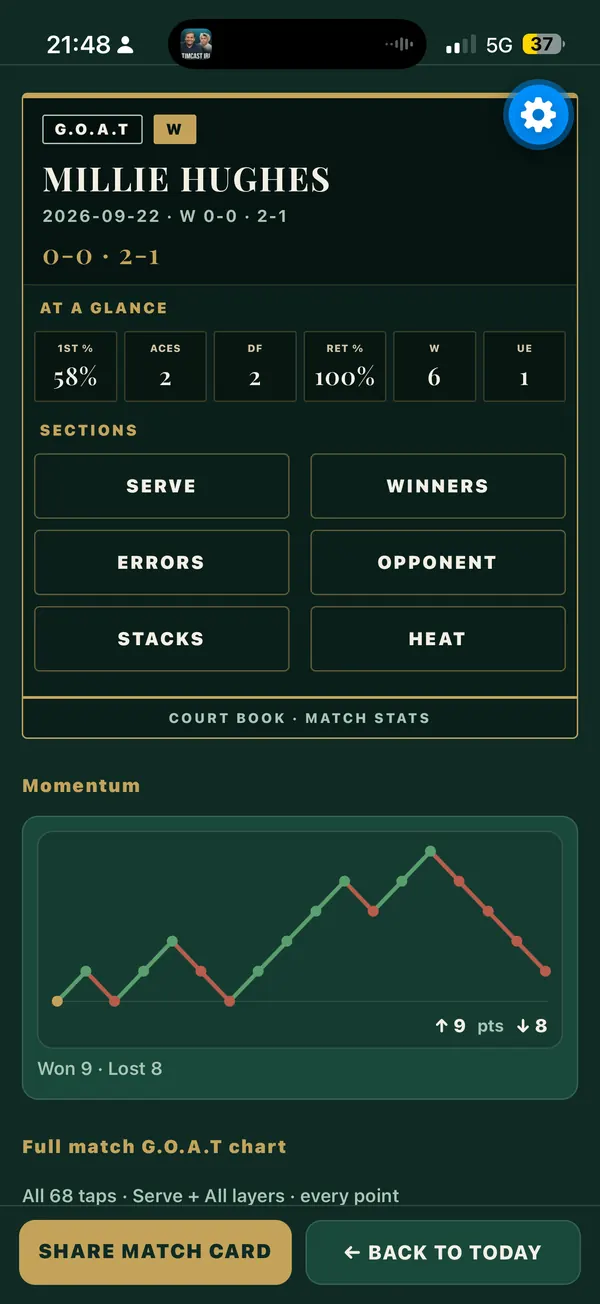
Match stats turn a coach's impression of a match into facts a player can act on. This guide explains the stats that matter most when you chart a match, what each one tells you, and how to use them in lessons.
First serve percentage
First serve percentage is the share of first serves that land in. Work it out as first serves in divided by first serves attempted. On its own it can mislead: a high percentage with few points won can mean the first serve is too safe.
Points won on first serve and second serve
Points won on first serve is the share of points won when the first serve went in. Points won on second serve is the share of points won when the player had to hit a second serve. The gap between the two shows how much the player relies on the first serve, and a low second serve figure usually points to a serve or first-ball pattern to work on.
Return points won
Return points won is the share of points won when the opponent is serving. It is the clearest single measure of how well a player is returning and building points from the back foot.
Unforced errors and forced errors
An unforced error is a mistake on a ball the player had the time and position to play well. A forced error is a mistake caused by the opponent's pressure, such as pace, depth or angle. Separating the two matters: lots of unforced errors suggests shot selection, consistency or decision-making, while lots of forced errors suggests the opponent is in control of the rallies.
Winners
A winner is a shot the opponent cannot touch, or an ace on serve. Compare winners with unforced errors for each player. A player who hits fewer winners than unforced errors is often giving away more points than they earn.
Heat maps
A heat map shows where on the court the ball landed and where points were won and lost. It shows patterns a scoreline cannot, such as balls landing short, errors clustering on one wing, or an opponent's targets.
Momentum
A momentum chart shows how the match swung point by point, not just the final score. It helps you find the moments where a set turned, such as after a missed break point or a run of unforced errors, which is often where the lesson is.
How to use match stats in lessons
- Pick one or two stats per match, not ten. Players act on a clear message.
- Start with the pattern, then the number. Show the heat map or momentum swing first, then the stat that explains it.
- Turn the stat into a drill. A low second serve points won figure becomes a session on second serve placement and the first ball after it.
- Chart again and compare. Track the same stats across matches so players see progress.
- Share with parents where it helps, so practice at home matches the plan.
Charting these stats with G.O.A.T. Coach
In G.O.A.T. Coach you tap the court to chart every point. Every serve is a single tap. The app builds live stats including first serve percentage, return points, aces, double faults, winners and unforced errors, along with heat maps, a momentum chart and player cards that update themselves. See how the G.O.A.T. chart works.
Questions
What are the most important tennis match stats for coaches?
The most useful match stats for coaches are first serve percentage, points won on first and second serve, return points won, winners, unforced errors and forced errors, plus heat maps for where points are won and lost and a momentum chart for how the match swung.
What is the difference between an unforced error and a forced error?
An unforced error is a mistake on a ball the player had time and position to play well. A forced error is a mistake caused by pressure from the opponent's shot.
Get the app
Two ways to use G.O.A.T. Coach
iPhone: download it from the App Store. Android, PC or Mac: use the web app in your browser, no download needed.

Lite £2.99 a month or Pro £9.99 a month. There is no free tier.